
SBTi Corporate Net-Zero Standard V2.0: What It Means for Companies and Carbon Markets
- SBTi is the dominant global net-zero standard, with 11,000+ companies, including Microsoft, Walmart, and Unilever, holding validated targets covering ~34 billion tCO₂e.
- V2.0 (published 11 June 2026) is SBTi’s first major revision, which after much discussion formally recognizing carbon credits and internal carbon pricing via its new Ongoing Emissions Responsibility (OER) framework.
- From 2035, large companies must cover a rising share of residual emissions with durable removals, reaching 100% by their net-zero year; avoidance credits stay ineligible.
- The market signal: current SBTi-aligned retirement is just 0.06% of covered emissions, against a 1% OER entry threshold, implying substantial latent demand once adoption scales, especially for durable removals ahead of the binding 2028/2035 deadlines.
The Science Based Targets initiative (SBTi) has become one of the most influential frameworks shaping voluntary corporate climate action. Established through a collaboration between CDP, the United Nations Global Compact, the We Mean Business Coalition, the World Resources Institute and WWF, it enables companies and financial institutions to set greenhouse gas reduction targets aligned with climate science.
More than 13,000 companies and financial institutions are now engaged with the initiative, of which nearly 12,000, including Microsoft, Walmart, Unilever, and H&M Group, hold validated targets covering an estimated 34 billion tCO₂e of Scope 1–3 emissions, with a further 2,400 committed to setting targets. This reach means changes to SBTi standards can materially influence corporate climate strategies and demand within the carbon market.
On 11 June 2026, the SBTi published Version 2.0 of its Corporate Net-Zero Standard, the framework through which companies set independently validated, 1.5°C-aligned emissions-reduction targets. The first major revision of the Standard, Version 2.0 introduces significant changes to what companies are expected to do, how progress is assessed and the role carbon credits may play alongside direct emissions reductions.
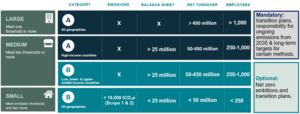
Differentiated obligations by company size and geography
Version 2.0 introduces two company categories that determine which obligations are mandatory versus optional. Category A comprises large companies (broadly, over 1,000 employees or €450 million turnover) and medium-sized companies based in high-income countries; these companies face mandatory transition plans, near-term Scope 3 targets, and the 2035 removals requirement described above. Category B comprises small companies and medium-sized companies in low-, lower-, and upper-middle-income countries, for whom net-zero ambitions, transition plans, and Scope 3 targets remain optional rather than mandatory.
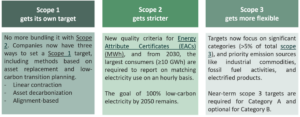
A more prescriptive standard across Scopes 1–3
Carbon credits are recognized under the Ongoing Emissions Responsibility (OER) Framework
Version 2.0 introduces the Ongoing Emissions Responsibility (OER) framework, replacing the SBTi’s prior Beyond Value Chain Mitigation guidance.

OER currently operates as a voluntary recognition program, structured around three tiers of ambition:

Participation remains voluntary, but on a comply-or-explain basis: every company declares its OER status at target validation, and declining requires a written justification submitted to the SBTi.
2035 onwards: Eligible CO2 removals for residual emissions
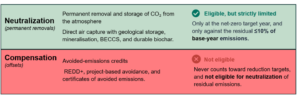
From 2035, the framework becomes binding for Category A companies (large companies, and medium-sized companies headquartered in high-income countries): they must cover a rising share of Scope 1-3 emissions, starting at 1% and increasing linearly to 100% by their net-zero target year, through eligible carbon removals. Within that requirement, at least 10% of covered emissions attributable to long-lived greenhouse gases (CO₂, N₂O, halogens) must be met with long-lived removals[1] – defined as storage of 1,000 years or more, such as direct air capture, BECCS, and durable biochar – with that share also rising to 100% by the net-zero year. At the net-zero target year itself, all companies, both Category A and B, must neutralize any remaining residual emissions through eligible removals, and disclose whether the credits used carry host-country authorization and Article 6 corresponding adjustments.
Transition Timeline
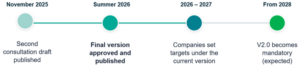
The current Standard (V1.3.1) remains valid for new and renewed targets through the transition period. Version 2.0 becomes available for target validation from 1 February 2027; V1.3.1 remains open for new submissions until 31 January 2028, after which Version 2.0 becomes mandatory for all target submissions, from 1 February 2028
Implications for carbon market demand
For carbon market, the new standard creates the structural conditions under which demand can materialize, conditional on corporate adoption. SBTi-aligned companies (roughly 11,000, covering an estimated 34 billion tCO₂e of Scope 1-3 emissions) retired approximately 20 million tonnes of credits in 2026, equivalent to about 0.06% of covered emissions – well short of the 1% threshold required for even the basic “Engaged” tier
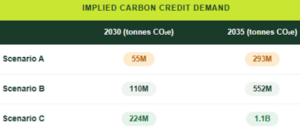
Assuming SBTi-covered emissions remain stable through 2030-35, potentially if the rate of emissions reductions is matched against the rate of increased SBTi participation. Table taken from, Sylvera Report, 2026, “The SBTi CNZ V2.0: Analysis of what comes next
Reaching that baseline threshold alone would imply demand on the order of 340 million tonnes annually, roughly 15 times current volumes. Independent modelling from Sylvera projects a comparable trajectory: a near-170% increase in SBTi-linked credit demand by 2030 under moderate adoption assumptions, rising toward an estimated 1.1 billion tonnes by 2035 in a more bullish adoption scenario.
The pace and scale of demand will depend on external pressure such as disclosure regulation, investor expectations, and procurement requirements. What the Standard does establish clearly is a durable-removals premium: SBTi flags that supply of long-lived removals (DAC, BECCS, biochar, enhanced rock weathering) is limited relative to the 2035 requirement. By committing now, companies can secure access to high-integrity credits backed by corresponding adjustments before demand increases ahead of the 2035 requirement. Early adoption can therefore reduce future procurement risk, provide greater cost certainty and help companies shape credible long-term carbon strategies.
Anna Citterio and Alexis Massot , EcoSecurities
[1] Eligible credits must be ex post and meet the SBTi’s additional integrity criteria: they may derive from activities that reduce emissions outside the company’s value chain, restore, protect, or enhance natural carbon sinks, or remove and store atmospheric carbon directly.