
Carbon finance: the catalyst climate finance needs at COP31
Less ODA doesn’t have to mean less climate finance, if carbon finance does the heavy lifting.
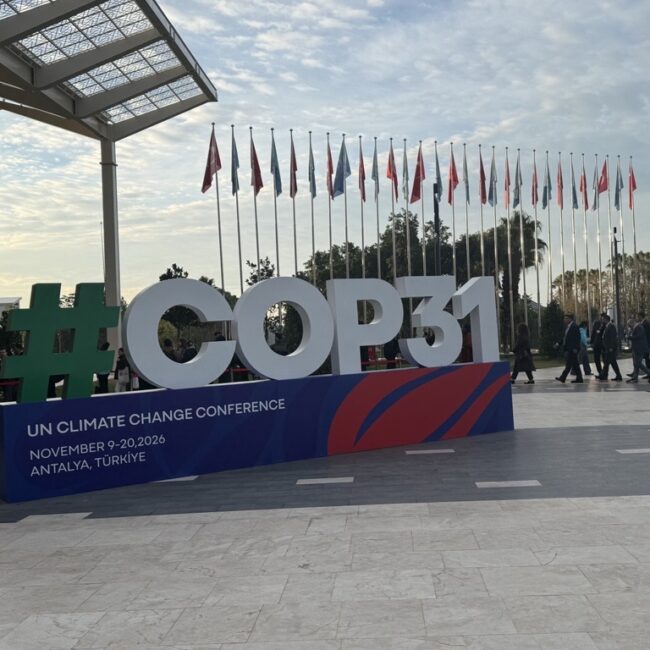
This week, delegations from close to 200 countries meet in Antalya, Türkiye, for COP31, the annual climate summit of the UN Framework Convention on Climate Change (UNFCCC), where governments negotiate how to deliver the Paris Agreement. It has been billed as the implementation COP, yet it opens with the hardest question still unanswered: who pays?
It is also the first COP to be jointly led by two countries, with Türkiye holding the Presidency and Australia leading the negotiations. Yet the preparatory talks in Bonn in June ended without agreement on finance or adaptation, so both arrive in Antalya unresolved.
The gap between what has been promised and what is being delivered explains why. Two years ago, at COP29 in Baku, countries set a new global goal (NCQG) for climate finance: developed countries agreed to mobilise at least $300bn a year for developing countries by 2035, with an aspiration to reach $1.3tn from “a broad spectrum of sources” (UNFCCC, 2024). At the same time, bilateral official development assistance (ODA) to the least developed countries fell by 25.8% in 2025, and the OECD expects a further 10.9% fall this year (OECD, 2026). Adaptation remains the poor relation: of a record $1.9tn in global climate finance in 2023 from public and private sources, only ~$65bn went to adaptation, according to Climate Policy Initiative’s Global Landscape of Climate Finance 2025 report. Public money alone will not close that gap. The question for Antalya is what can help it go further.
A catalyst, not a substitute
One solution is carbon finance. It will not replace public climate finance, and it should not try to, but its value lies in working alongside ODA and concessional finance, so that scarce public money works harder and crowds in far more private capital. It does this in three ways.
First, at home. Carbon pricing and domestic carbon markets raise national revenue and build demand through local markets that governments control.
Second, across borders. Under Article 6 of the Paris Agreement, governments and companies can pay for emission reductions in another country. The host country decides what to authorise and on what terms, so these reductions serve their own development and climate plans.
Third, and most important, as a catalyst. A predictable carbon revenue stream can back guarantees and blended finance structures which lower risk enough for local banks and institutional investors to lend to projects they would otherwise avoid.
The evidence is already there
According to Convergence’s State of Blended Finance 2026, blended finance held steady at $25.8bn in 2025, despite the largest annual fall in ODA on record. Each concessional dollar supported $5.33 in commercial finance and private commitments rose 27% to $11.2bn.
Currently, however, capital is flowing to where risk is easiest to manage. Sub-Saharan Africa’s share of blended finance deals fell from 34% to 19% last year. The binding constraint is risk, which is highest where investment matters most. Distributed renewable energy, such as off-grid solar, mini-grids and solar irrigation, relies on many small customers that lenders struggle to assess. Climate-smart agriculture carries higher risk still: smallholder credit in Africa often costs 25-30%. This year’s super-charged El Niño will bring that risk into focus even further as its impact on harvests extends into 2027.
Carbon revenue is one of the few sources of risk-absorbing capital that does not depend on ODA budgets. That revenue is also becoming more predictable. The International Air Transport Association (IATA) expects airlines to need around 200 million eligible credits in the first phase of the CORSIA scheme, against roughly 40 million available so far, and from 2027 the second phase brings almost all international flights into scope. Moreover, sovereign demand is growing, with the governments of Japan, South Korea, Singapore, Switzerland and Scandinavia already buying under Article 6.
What it looks like on the ground
Take smallholder farmers. More than 285 million smallholder households globally need over $320bn a year in credit, but receive less than a third of that. In Kenya, agriculture generates 23% of GDP yet receives under 3% of bank credit, and farmers who can borrow often pay up to 30% interest.
The Watts and Water programme, which EcoSecurities is jointly developing with the Kenya Climate Innovation Center (KCIC) with support from UNDP, is designed to make that finance affordable. Carbon credits from thousands of solar pumps are pooled and pre-sold to a European government buyer under an Article 6.2 agreement (a mechanism under the UN Paris Agreement that lets one country buy emissions reductions from another and count them towards its own climate target, with the seller country agreeing not to claim them too). Most carbon projects simply knock the value of the credits off the price of the product, as a one-off discount. Here, the revenue does two longer-lasting jobs. It pays for technical support for farmers and cooperatives over many years, helping them raise yields two to four times. And it capitalises a guarantee fund that takes a first loss on lenders’ portfolios, so they can cut interest rates, ask for less collateral and spread repayments over the life of the pump. Used this way, carbon finance crowds in local lending, in addition to subsidising a product. Furthermore, the structure can be adapted to finance other climate-smart technologies and tailored for replication in other countries.
In Zambia, for example, only a third of rural households have electricity, and small renewable projects can face a local cost of capital of around 30%. The Renewable Energy Access and Carbon Finance Programme (REACH), which EcoSecurities is developing with support from UNDP, brings carbon finance to a portfolio of more than ten solar and run-of-river hydro projects. Structured as a programme of activities, it aggregates small projects for which accessing carbon markets on their own would be uneconomical, so carbon revenue can become part of their overall financing mix and help bring down the cost of capital. The lesson from both is that carbon finance has most impact when it sits within a wider blended finance structure. There, it can reduce risk, provide a long-term and predictable source of funding, and help mobilise climate finance at scale.
None of this works without a strong pipeline of investable projects. In Jordan and Paraguay with the Global Green Growth Institute (GGGI), and in Rwanda with the Rwandan Development Bank (BRD), EcoSecurities is helping to build pipelines of Article 6 projects aligned with each country’s national climate plan. The next step is incubation and aggregation vehicles of the right size and scale to bring carbon finance to smaller, earlier-stage ventures. Here again, carbon finance can play a truly catalytic role. By anchoring guarantees and first-loss structures, it gives local and international financial institutions the risk cover they need to lend on affordable terms, while funding the long-term technical assistance that helps these ventures grow.
Transparency and shared risk
Much of the architecture is now in place, from host-country frameworks and legislation to standards such as Gold Standard, Verra and the UNFCCC’s Paris Agreement Crediting Mechanism. As GGGI’s gathering in Seoul heard last month, the focus is now shifting to implementation and to making projects bankable. That depends on transparency, robust tracking and reporting, clear and timely decisions, and a fair share of benefits for communities.
Buyers can also share the risk through pre-financing. Paying part of the price before credits are issued means the delivery risk does not all fall on the project developer. It also provides the early capital projects find hardest to raise and shows lenders that the demand is real.
Carbon finance cannot work in isolation, or be kept in a separate box from ODA. As the Climate Policy Initiative has concluded, it cannot do the job “by itself” – it works best as part of a broader blended finance structure. But within that structure, it can do the heavy lifting: de-risking investment and providing a long-term, sustainable source of funding for critical technical assistance, just as ODA is falling.
What COP31 needs to deliver
With 221 Article 6.2 projects under development, 45 advanced implementation agreements, and 113 wider bilateral arrangements in place, and the UNFCCC’s new crediting mechanism is issuing its first credits. What is missing is demand, and enough bankable projects to meet it. Four things would change that.
More buyers, sharing more of the risk. Germany has launched a tender for 1.1 million credits under the UNFCCC mechanism, and Korea is working with GGGI on a Global Verified Carbon Market. Canada should follow its consultation with firm purchase plans, the EU should use its 2031–2035 pilot to make real purchases, and CORSIA’s second phase should give airlines and host countries a clear view of demand. Buyers should also offer pre-financing, so that risk does not fall on developers alone.
Bring ODA and carbon finance together. Any COP31 decision on the road to $1.3tn, or on tripling adaptation finance, should recognise carbon finance as a source and deploy it alongside ODA and concessional capital, so that every dollar works harder and crowds in more climate finance.
Make projects bankable. Development banks and donors should back guarantees and first-loss structures anchored by carbon revenue, and fund the incubation and aggregation vehicles that bring smaller projects to scale.
Keep the system transparent. Negotiators should agree stable funding for the registries and reporting systems Article 6 relies on, and ensure clear, timely approvals under the UNFCCC mechanism.
The rules for carbon markets were the work of the last decade. The test in Antalya is whether governments and companies now use them. The countries that need climate finance most cannot wait for ODA budgets to recover. Carbon finance, working alongside ODA and concessional finance, can help them move now.
By Simon Retallack, CEO, EcoSecurities